Nothing About Us Without Us
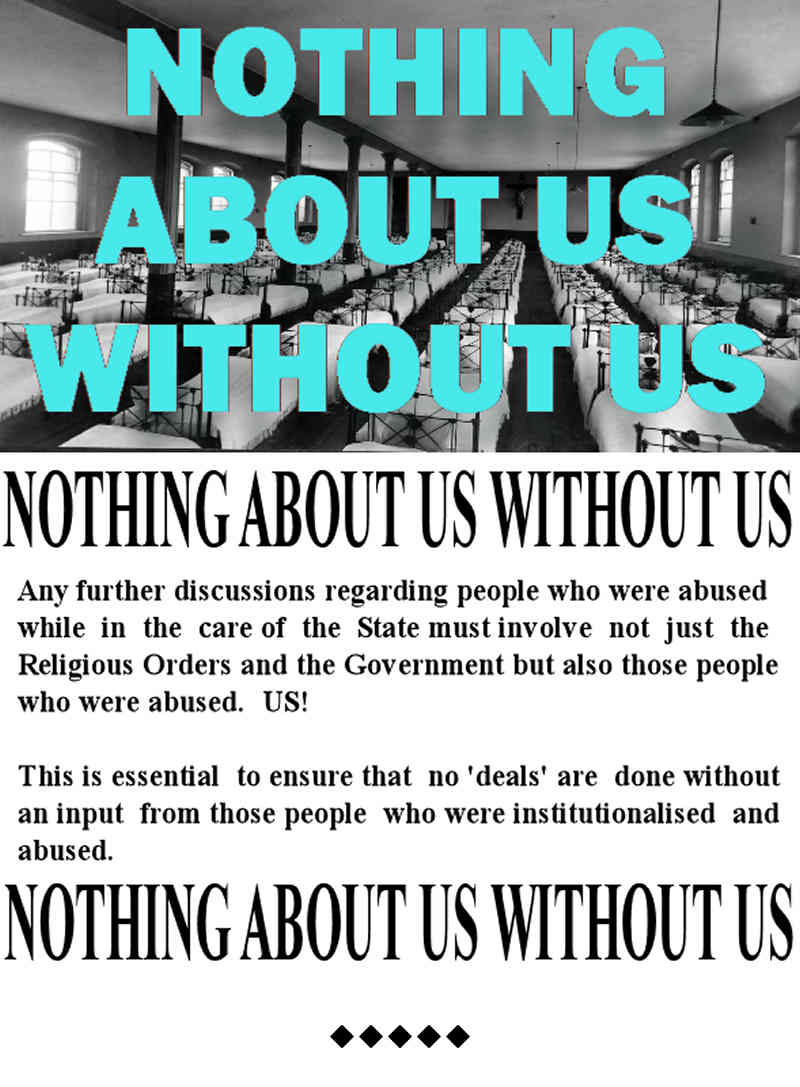
Nothing About Us without Us
[click on image to enlarge it ]
I hold fast to the view that there must be no more deals, secret or otherwise done between Religious orders and the Government of Ireland without indepth consultation with people who were abused while in the care of religious orders or the state.
Paddy.

We reveal 11 people given pseudonyms who are criticised in the abuse report
John Downes, News Investigations Correspondent Sunday Tribune.

The Sunday Tribune today publishes the names of 11 people given anonymous identities in the report of the Commission to Inquire into Child Abuse. All of those identified are criticised either for administering physical or sexual abuse, or for failing to prevent it happening to the children in their care.

The list of names includes two former managers of schools who were appointed Provincials of their religious orders, and a nun, Sister Xaviera (Severia), who famously defended her record on Prime Time after revelations of abuse emerged in the 1996 Dear Daughter documentary about Goldenbridge. She is given the pseudonym ‘Sr Alida’ and is accused of beating children and for letting her enthusiasm for the making of rosary beads at Goldenbridge become an “obsession”.

Former Rosminian Provincial Fr Patrick Pierce, who managed the now infamous Ferryhouse school in Clonmel from 1975 to 1991, is given the pseudonym ‘Fr Stefano’.

Read more

There is still a sense that the ‘holy’ fat cats will be allowed to escape with their riches intact, writes Emer O’Kelly

Sunday May 31 2009

ARCHBISHOP Diarmuid Martin doesn’t know; Father Sean Healy of the Conference of Religious of Ireland doesn’t know; Sister Marianne O’Connor director-general of the Conference of Religious of Ireland doesn’t know; the Minister for Justice doesn’t know; the Christian Brothers’ Superior doesn’t know.

None of them knows, they claim (correctly in the Minister’s case) how much money and assets belong to the religious congregations in Ireland, the criminals who tortured children and profiteered from their unpaid labour for generations. But even now, they will not easily give them up; that is clear after the revelations and statements of the last terrible week

We have something called the Criminal Assets Bureau in Ireland. It has the powers to freeze assets, access bank accounts, and confiscate the proceeds of crime. It was never imagined that the CAB would have to carry out its work in such sickening circumstances.

But there is the machinery to swoop on these criminal organisations (the religious congregations) and ensure that they are never again in a position to live off the backs of little children, children who in many cases had those backs laid open to the bone with whips, flails and leather belts.

Read more

We need to shed our certainty that all this abuse can be blamed on aberrant religious, writes BREDA O’BRIEN

IT IS fascinating to read the ISPCC’s press release on the Ryan report. It attempts to explain the background to the “cruelty men” and its role in committing children to industrial schools.

“The societal, economic, environmental, and personal limitations within which parents were attempting to raise their children . . . included abject poverty, substandard housing, lack of employment, poor sanitation, absentee fathers, excessive use of alcohol, and the condemnation and unacceptability of illegitimacy. It was these factors which led to the vast majority of referrals to the society’s inspectors coming from the general public, including the families themselves, and it was these factors that often meant leaving a child in the home environment was not an option.”

What would the reaction have been if any representative of a religious order had issued a similar statement this week? No doubt they would have been tarred and feathered. Yet no such reaction has greeted the ISPCC’s statement.

The Ryan report mentions that Frank Duff, the founder of the Legion of Mary, and a critic of industrials schools, referred to one woman ISPCC inspector who was “dangerous” and who was “shovelling children into industrial schools”. Virtually all the inspectors were male, so it should be relatively easy to find and name this woman. There is no interest in doing so, in stark contrast to the religious who have been named in recent days.
Read more

Off the hook

Saturday, May 30, 2009

IT was the NSPCC and the ISPCC that had us taken to court, charged and sentenced, for a bounty.

This has left us with a criminal conviction. Did they check these places out? No.

They have not paid a penny and they apologised only a few days ago. Why are they being left of the hook when they kept on having children sent to these institutions?

Kathy Ferguson
Jacox Crescent
Kenilworth
England CV8 2NJ

By Bruce Arnold

Saturday May 30 2009

For a week the Irish people have wallowed in an orgy of sentimental breast-beating about the agony of children incarcerated in the Irish gulag of industrial schools.

Politicians have expressed surprise and astonishment, then dismay and determination to act. Yet the facts have been known for at least a decade. Those in power took draconian action in collusion with the Church. They did so against those who had been abused.

They have sought to minimise their own abuse of human rights. They exonerate by silence the legal breaches perpetrated by their predecessors. For generations they engaged in a political cover-up.

The opposition leaders, Enda Kenny and Eamon Gilmore, knew a great deal, yet their spokespersons were slow to act in response to appeals from the abused. They expressed loudly their astonishment at Ryan Report revelations — presented regularly by the press since 1999. They called for re-negotiation of the indemnity deal, knowing this was impossible. Though futile, they demanded a new offer from the religious orders.
Read more

In the Irish gulags abusers roamed free because children didn’t matter

By Fergus Finlay

Tuesday, May 26, 2009

I DROVE to Clonmel on Sunday for the finals of an under-nines and under-10s football tournament. It was organised by Clonmel FC and brought together young footballers from the six Munster counties. They (and the rest of us) had a brilliant afternoon and we were made to feel really welcome by the Clonmel team.

“Kids for kids” is the slogan of this invitational tournament, and it raises money for the work we do in Barnardos. It’s a great idea that, isn’t it – kids enjoying their sport, really having a go at competition, learning a bit about themselves in the process and raising a few bob for other kids along the way.

All the clubs that took part have wonderful youth policies and they’re all staffed (if that’s the word) by dedicated volunteers – coaches and parents, and people who’ve given their lives to their clubs and the kids they work with, year in and year out.

Looking at the kids playing, each of them able to imagine a bright future as the next Roy Keane or Damien Duff, and watching the pride and joy of their parents and coaches, you could almost forget for a moment the darkness that unfolded across our country last week.

But in some ways the contrast between the happy-go-lucky kids I met on Sunday and the tortured, hunted children I’ve been reading about all week made it even more painful.

I don’t feel I have the right to speak for the survivors of institutional abuse in Ireland. I’ve met many of them over the years and I’m in awe of their courage and determination.

The anger of people like Christine Buckley and John Kelly, even today in the wake of their total vindication, is both palpable and entirely justified. Theirs is the authentic voice of reproach to a system that betrayed them and left them in hell.

And yet I do believe the rest of us have an obligation to try to analyse this and to see what sense, if any, can be made of it. I heard someone on radio say the other day that everyone over 50 in Ireland shares some portion of the blame for what happened.

I’m not sure if I agree with that – but I do keep asking myself the same question: if I had known, would I have tried to stop it? Because there is one conclusion that I believe has to be faced up to after you finish reading the report of the commission, and it is this: power corrupts, and absolute power corrupts absolutely. That is no cliché; it is the most profound point of the entire history of institutional care in Ireland. The torture and degradation of generations of children was not the work of bad apples. It was the result of a corrupt system. The failure to stop it was not the result of oversight or mistake. It was part of the same corruption.
Read more

Its shame confirmed by an official report, it’s time to pronounce the last rites for the Roman Catholic Church in Ireland
David Sharrock

A storm is blowing through Ireland, its moral outrage unprecedented in the state’s history. For the Roman Catholic Church and Irish society, its consequences will be profound.

The plain-speaking of one man merits lengthy quotation. Michael O’Brien articulated the rage of a nation this week when he appeared on the RTÉ show Questions and Answers, the Republic’s equivalent of the BBC’s Question Time.

He listened patiently to the answers given by politicians to his question about whether the assets of religious orders found guilty by a commission report of systemic, endemic child abuse should be frozen. Then he let rip.
Read more

It would appear that the findings from the recently released report on

child abuse in Ireland is having positive impacts with the media,

politicians and maybe even those responsible for years of organised,

ongoing abuse.

The issue now appears to the be to achieve equity. One of the main ways

to achieve this is payment and amount of damages to be paid by those

responsible.

A settlement between Church and State, previously arrived at, is now,

at last seen by most as completely flawed, forcing politicians and

others in positions in power to backtrack on what they achieved in

their “Secret Deal”.

Can someone explain how the original amount was calculated in the above

mentioned document and if so, was the level of abuse known or fully

understood?

Did some civil servant sit in their office, making calculations on the

perceived value of a rape, a beating or even a death?

Did the rate for these vary, depending on the frequency of one of these

events?

Did the costs vary from institution to institution?

We can’t move forward or consider what the payment level should be

until it is known how the original figure was calculated.

In addition, we need to know the schedule of repayments agreed was

adhered to and honoured by the organisations responsible for this

immovable slur on Ireland.

If property was not handed over at the time of the agreement, then have

these religious authorities have gained value from the then increasing

values for property and land prices, possibly even to the extent of

removing much, if not most of the financial penalties they incurred for

their management of these “centres of pain”.

I know that whatever amount is finally agreed and extracted, can never

make up for each individuals pain and suffering.

It will also never account for the social, health and other economic

costs that have continued as a result of their actions.

Those that pay taxes pay are and will pay for the damage done, directly

or indirectly.

The State misused their position and the Church, through these

organisations abused the public donations, who by their support bought,

paid and maintained these centres.

Martin
See
Secret Deal Between Church and State

‘It was murder of the soul’

A terrible legacy is born. What emerges from the publication of the Ryan Commission’s report on the penal system in which thousands of Irish children were incarcerated for long periods of their lives, is that Church and state are still one, still arm in arm, and that they will protect each other, no matter what.

There are many ways in which violence is perpetrated on humans by humans. As Oscar Wilde said, some do it with a kiss, some do it with a sword.

The Irish state does it with a report. Silence is violence, because in that silence is the hurt and the stress caused by denial. The unacknowledged impact of what happened to the children of Ireland will not rest and we will further traumatise generations to come with what the Irish state has done by failing to honour the universal code of natural law.

People will frenzy obsessively, as they have in the past, around the sordid details of sexual abuse. They will look for extreme examples to measure the extent of its brutality.

Sexual assault is merely a term employed to describe parts of the human body and human biology. It belittles, to some extent and, to another extent, sexualises violence for the onlooker and the reader. But for the victim there is no sexual aspect; there is just the extreme violence of the act perpetrated on them. The act is immeasurable, as its impact ebbs and flows and bashes against the coast of the individual’s life, gnawing away at personhood and spirit forever.
Read more

Next Page →